

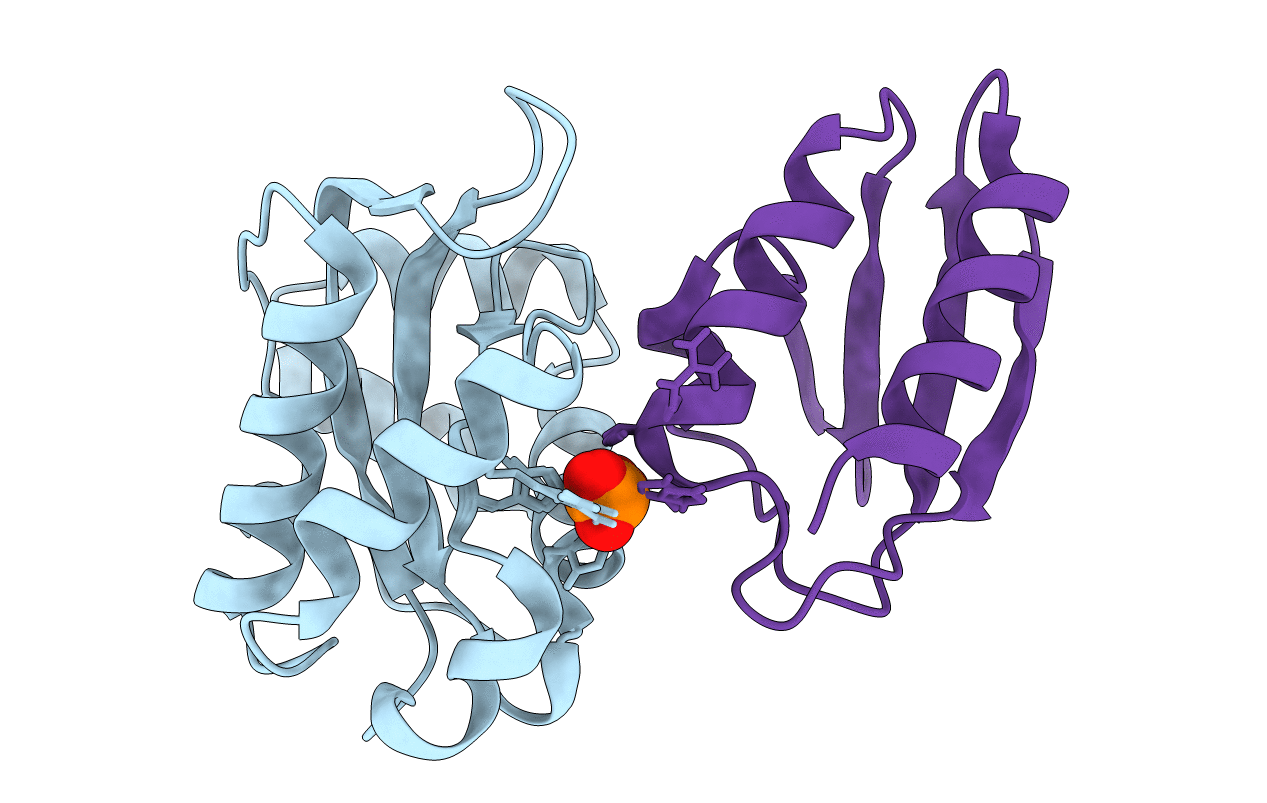
1J6T image
Deposition Date 2002-08-14
Release Date 2002-11-13
Last Version Date 2024-05-22
Entry Detail
PDB ID:
1J6T
Keywords:
Title:
COMPLEX OF ENZYME IIAMTL AND THE HISTIDINE-CONTAINING PHOSPHOCARRIER PROTEIN HPR FROM ESCHERICHIA COLI NMR, RESTRAINED REGULARIZED MEAN STRUCTURE
Biological Source:
Source Organism(s):
Escherichia coli (Taxon ID: 562)
Expression System(s):
Method Details:
Experimental Method:
Conformers Calculated:
200
Conformers Submitted:
3
Selection Criteria:
REGULARIZED MEAN STRUCTURES

Macromolecular Entities
Structures with similar UniProt ID
Protein Blast
Polymer Type:polypeptide(L)
Molecule:PTS SYSTEM, MANNITOL-SPECIFIC
Gene (Uniprot):mtlA
Chain IDs:A
Chain Length:148
Number of Molecules:1
Biological Source:Escherichia coli
Structures with similar UniProt ID
Protein Blast
Polymer Type:polypeptide(L)
Molecule:Phosphocarrier protein HPr
Gene (Uniprot):ptsH
Chain IDs:B
Chain Length:85
Number of Molecules:1
Biological Source:Escherichia coli
Ligand Molecules
Primary Citation
Solution Structure of the Phosphoryl Transfer Complex between the Cytoplasmic A Domain of the Mannitol Transporter IImannitol and HPr of the Escherichia coli Phosphotransferase System
J. Biol. Chem. 277 42289 42298 (2002)
PMID: 12202490 DOI: 10.1074/jbc.M207314200

Abstact

The solution structure of the complex between the cytoplasmic A domain (IIA(Mtl)) of the mannitol transporter II(Mannitol) and the histidine-containing phosphocarrier protein (HPr) of the Escherichia coli phosphotransferase system has been solved by NMR, including the use of conjoined rigid body/torsion angle dynamics, and residual dipolar couplings, coupled with cross-validation, to permit accurate orientation of the two proteins. A convex surface on HPr, formed by helices 1 and 2, interacts with a complementary concave depression on the surface of IIA(Mtl) formed by helix 3, portions of helices 2 and 4, and beta-strands 2 and 3. The majority of intermolecular contacts are hydrophobic, with a small number of electrostatic interactions at the periphery of the interface. The active site histidines, His-15 of HPr and His-65 of IIA(Mtl), are in close spatial proximity, and a pentacoordinate phosphoryl transition state can be readily accommodated with no change in protein-protein orientation and only minimal perturbations of the backbone immediately adjacent to the histidines. Comparison with two previously solved structures of complexes of HPr with partner proteins of the phosphotransferase system, the N-terminal domain of enzyme I (EIN) and enzyme IIA(Glucose) (IIA(Glc)), reveals a number of common features despite the fact that EIN, IIA(Glc), and IIA(Mtl) bear no structural resemblance to one another. Thus, entirely different underlying structural elements can form binding surfaces for HPr that are similar in terms of both shape and residue composition. These structural comparisons illustrate the roles of surface and residue complementarity, redundancy, incremental build-up of specificity and conformational side chain plasticity in the formation of transient specific protein-protein complexes in signal transduction pathways.

Legend

Protein

Chemical

Disease

Primary Citation of related structures
Feedback Form
Name
Email
Institute
Feedback