

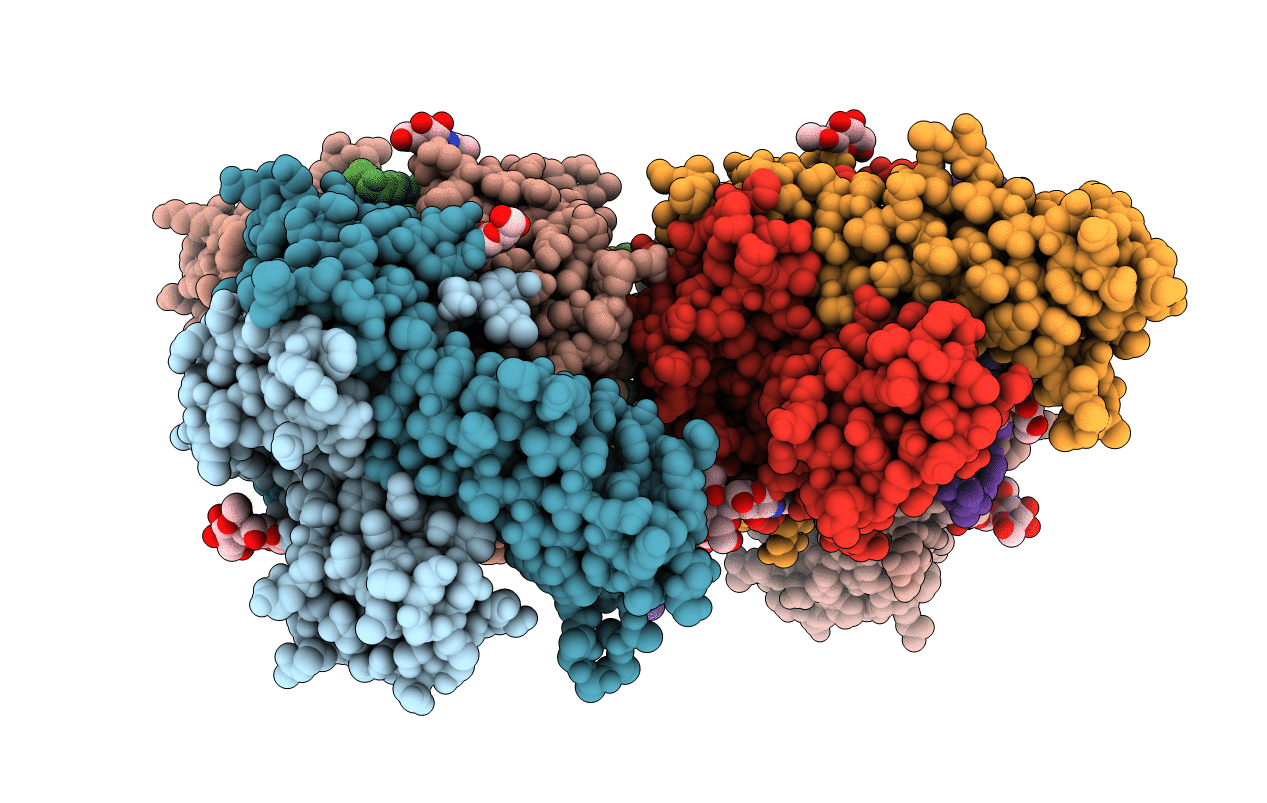
1I3R image
Deposition Date 2001-02-15
Release Date 2001-06-20
Last Version Date 2024-10-30
Entry Detail
PDB ID:
1I3R
Keywords:
Title:
CRYSTAL STRUCTURE OF A MUTANT IEK CLASS II MHC MOLECULE
Biological Source:
Source Organism(s):
Mus musculus (Taxon ID: 10090)
Expression System(s):
Method Details:
Experimental Method:
Resolution:
2.40 Å
R-Value Free:
0.27
R-Value Work:
0.22
Space Group:
P 1 21 1

Macromolecular Entities
Structures with similar UniProt ID
Protein Blast
Polymer Type:polypeptide(L)
Molecule:H-2 CLASS II HISTOCOMPATIBILI
Mutagens:E11Q, D66N
Chain IDs:A, C, E, G
Chain Length:192
Number of Molecules:4
Biological Source:Mus musculus
Protein Blast
Polymer Type:polypeptide(L)
Molecule:FUSION PROTEIN CONSISTING OF
Gene (Uniprot):Hbb-b2
Chain IDs:B, D, F, H
Chain Length:228
Number of Molecules:4
Biological Source:Mus musculus
Modified Residue
Compound ID Chain ID Parent Comp ID Details 2D Image
ASN A ASN GLYCOSYLATION SITE
Ligand Molecules
Primary Citation
Mutations changing the kinetics of class II MHC peptide exchange.
Immunity 14 513 522 (2001)
PMID: 11371354 DOI: 10.1016/S1074-7613(01)00140-6

Abstact

IE/DR MHC class II molecules have an extensive H-bonding network under the bound peptide. In IE(k), two alpha chain acidic amino acids in the core of this network were mutated to amides. At low pH, the mutant molecule exchanged peptide much more rapidly than the wild-type. The crystal structure of the mutant IE(k) revealed the loss of a single buried water molecule and a reorganization of the predicted H-bonding network. We suggest that these mutations enhance the transition of MHC class II to an open conformation at low pH allowing the bound peptide to escape. In wild-type IE(k), the need to protonate these amino acids also may be a bottleneck in the return to a closed conformation after peptide binding.

Legend

Protein

Chemical

Disease

Primary Citation of related structures
Feedback Form
Name
Email
Institute
Feedback