

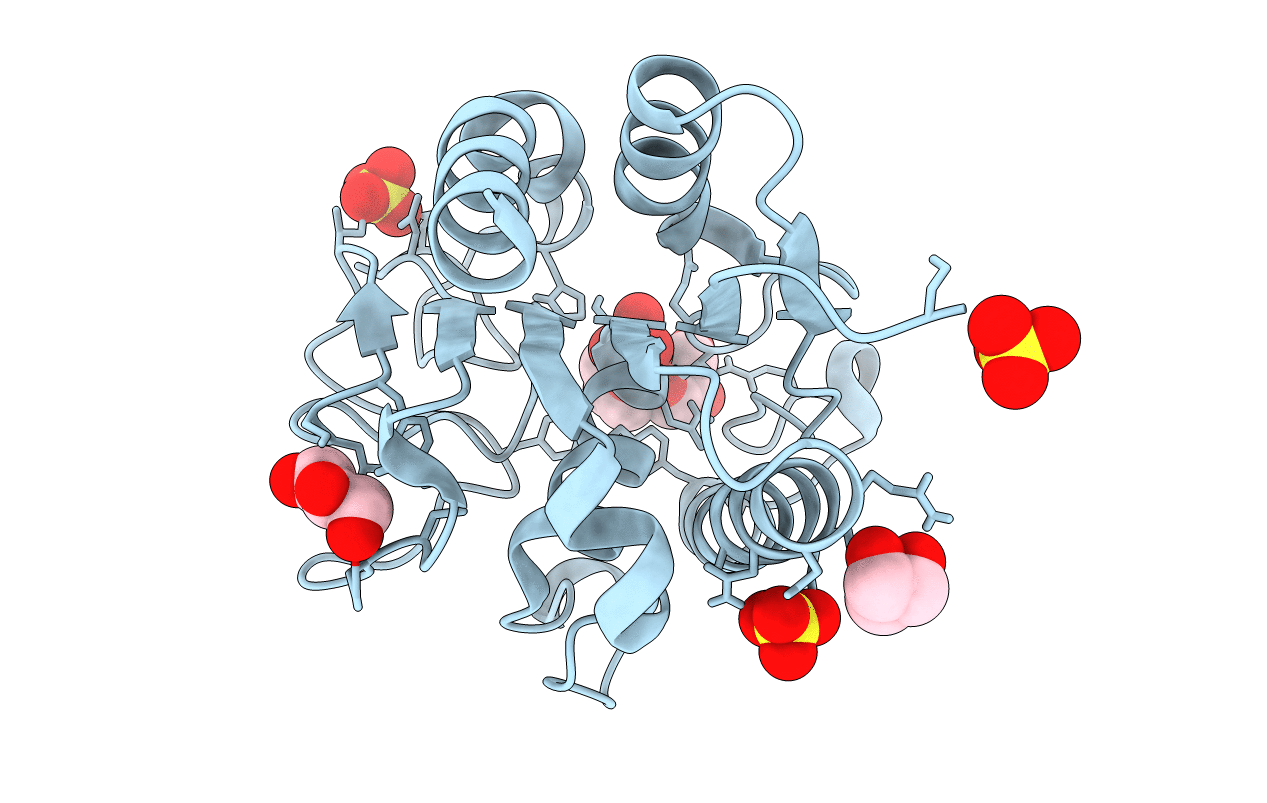
1G66 image
Deposition Date 2000-11-03
Release Date 2001-01-17
Last Version Date 2024-12-25
Entry Detail
PDB ID:
1G66
Keywords:
Title:
ACETYLXYLAN ESTERASE AT 0.90 ANGSTROM RESOLUTION
Biological Source:
Source Organism(s):
Method Details:
Experimental Method:
Resolution:
0.90 Å
R-Value Free:
0.13
R-Value Work:
0.10
R-Value Observed:
0.10
Space Group:
P 21 21 21

Macromolecular Entities
Structures with similar UniProt ID
Protein Blast
Polymer Type:polypeptide(L)
Molecule:ACETYL XYLAN ESTERASE II
Gene (Uniprot):axe-2
Chain IDs:A
Chain Length:207
Number of Molecules:1
Biological Source:Penicillium purpurogenum
Primary Citation
Multiple conformations of catalytic serine and histidine in acetylxylan esterase at 0.90 A.
J. Biol. Chem. 276 11159 11166 (2001)
PMID: 11134051 DOI: 10.1074/jbc.M008831200

Abstact

Acetylxylan esterase (AXEII; 207 amino acids) from Penicillium purpurogenum has substrate specificities toward acetate esters of d-xylopyranose residues in xylan and belongs to a new class of alpha/beta hydrolases. The crystal structure of AXEII has been determined by single isomorphous replacement and anomalous scattering, and refined at 0.90- and 1.10-A resolutions with data collected at 85 K and 295 K, respectively. The tertiary structure consists of a doubly wound alpha/beta sandwich, having a central six-stranded parallel beta-sheet flanked by two parallel alpha-helices on each side. The catalytic residues Ser(90), His(187), and Asp(175) are located at the C-terminal end of the sheet, an exposed region of the molecule. The serine and histidine side chains in the 295 K structure show the frequently observed conformations in which Ser(90) is trans and the hydroxyl group is in the plane of the imidazole ring of His(187). However, the structure at 85 K displays an additional conformation in which Ser(90) side-chain hydroxyl is away from the plane of the imidazole ring of His(187). The His(187) side chain forms a hydrogen bond with a sulfate ion and adopts an altered conformation. The only other known hydrolase that has a similar tertiary structure is Fusarium solani cutinase. The exposed nature of the catalytic triad suggests that AXEII is a pure esterase, i.e. an alpha/beta hydrolase with specificity for nonlipidic polar substrates.

Legend

Protein

Chemical

Disease

Primary Citation of related structures
Feedback Form
Name
Email
Institute
Feedback