

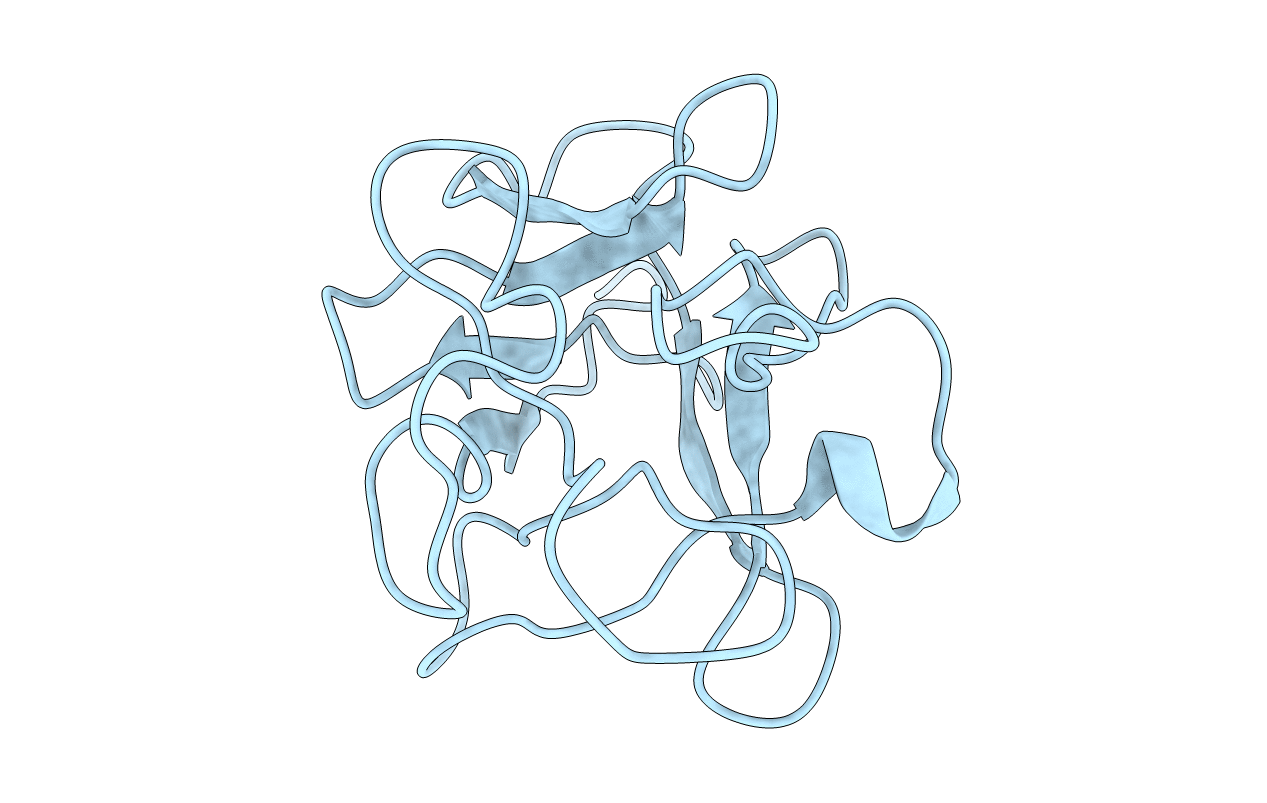
1FMM image
Deposition Date 2000-08-18
Release Date 2001-08-18
Last Version Date 2024-05-22
Entry Detail
PDB ID:
1FMM
Title:
SOLUTION STRUCTURE OF NFGF-1
Biological Source:
Source Organism(s):
Expression System(s):
Method Details:
Experimental Method:
Conformers Calculated:
50
Conformers Submitted:
1
Selection Criteria:
structures with the least restraint violations
Macromolecular Entities
Structures with similar UniProt ID
Protein Blast
Polymer Type:polypeptide(L)
Molecule:ACIDIC FIBROBLAST GROWTH FACT
Gene (Uniprot):fgf1
Chain IDs:A (auth: S)
Chain Length:132
Number of Molecules:1
Biological Source:Notophthalmus viridescens
Ligand Molecules
Primary Citation
Structure and stability of an acidic fibroblast growth factor from Notophthalmus viridescens.
J.Biol.Chem. 277 46424 46432 (2002)
PMID: 12205097 DOI: 10.1074/jbc.M207814200

Abstact

The three-dimensional solution structure of an acidic fibroblast growth factor (nFGF-1) from the newt (Notophthalmus viridescens) is determined using multidimensional NMR techniques. Complete assignment of all the atoms ((1)H, (15)N, and (13)C) has been achieved using a variety of triple resonance experiments. 50 structures were calculated using hybrid distance geometry-dynamical simulated annealing technique with a total of 1359 constraints. The atomic root mean square distribution for the backbone atoms in the structured region is 0.60 A. The secondary structural elements include 12 beta-strands arranged antiparallely into a beta-barrel structure. The protein (nFGF-1) exists in a monomeric state upon binding to the ligand, sucrose octa sulfate (SOS), in a stoichiometric ratio of 1:1. The SOS binding site consists of a dense cluster of positively charged residues located at the C-terminal end of the molecule. The conformational stabilities of nFGF-1 and its structural and functional homologue from the human source (hFGF-1) are drastically different. The differential stabilities of nFGF-1 and hFGF-1 are attributed to the differences in the number of hydrogen bonds and the presence of solvent inaccessible cavities in the two proteins.

Legend

Protein

Chemical

Disease

Primary Citation of related structures
Feedback Form
Name
Email
Institute
Feedback