

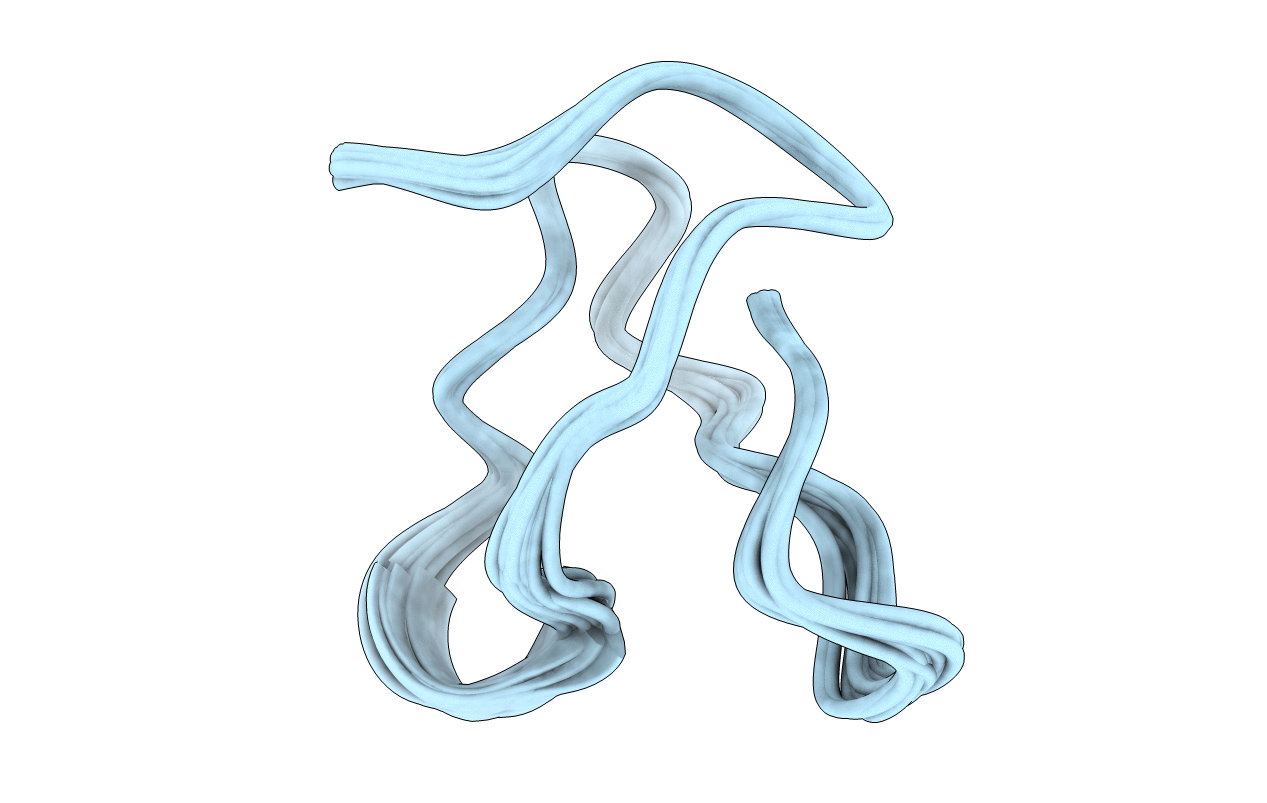
1CNN image
Deposition Date 1999-05-20
Release Date 2000-05-31
Last Version Date 2024-11-13
Entry Detail
PDB ID:
1CNN
Keywords:
Title:
OMEGA-CONOTOXIN MVIIC FROM CONUS MAGUS
Method Details:
Experimental Method:
Conformers Calculated:
50
Conformers Submitted:
17
Selection Criteria:
LEAST RESTRAINT VIOLATION

Macromolecular Entities
Structures with similar UniProt ID
Protein Blast
Polymer Type:polypeptide(L)
Molecule:OMEGA-CONOTOXIN MVIIC
Chain IDs:A
Chain Length:27
Number of Molecules:1
Biological Source:
Ligand Molecules
Primary Citation
Structure-activity relationships of omega-conotoxins MVIIA, MVIIC and 14 loop splice hybrids at N and P/Q-type calcium channels.
J. Mol. Biol. 289 1405 1421 (1999)
PMID: 10373375 DOI: 10.1006/jmbi.1999.2817

Abstact

The omega-conotoxins are a set of structurally related, four-loop, six cysteine containing peptides, that have a range of selectivities for different subtypes of the voltage-sensitive calcium channel (VSCC). To investigate the basis of the selectivity displayed by these peptides, we have studied the binding affinities of two naturally occurring omega-conotoxins, MVIIA and MVIIC and a series of 14 MVIIA/MVIIC loop hybrids using radioligand binding assays for N and P/Q-type Ca2+channels in rat brain tissue. A selectivity profile was developed from the ratio of relative potencies at N-type VSCCs (using [125I]GVIA radioligand binding assays) and P/Q-type VSCCs (using [125I]MVIIC radioligand binding assays). In these peptides, loops 2 and 4 make the greatest contribution to VSCC subtype selectivity, while the effects of loops 1 and 3 are negligible. Peptides with homogenous combinations of loop 2 and 4 display clear selectivity preferences, while those with heterogeneous combinations of loops 2 and 4 are less discriminatory. 1H NMR spectroscopy revealed that the global folds of MVIIA, MVIIC and the 14 loop hybrid peptides were similar; however, several differences in local structure were identified. Based on the binding data and the 3D structures of MVIIA, GVIA and MVIIC, we have developed a preliminary pharmacophore based on the omega-conotoxin residues most likely to interact with the N-type VSCC.

Legend

Protein

Chemical

Disease

Primary Citation of related structures
Feedback Form
Name
Email
Institute
Feedback