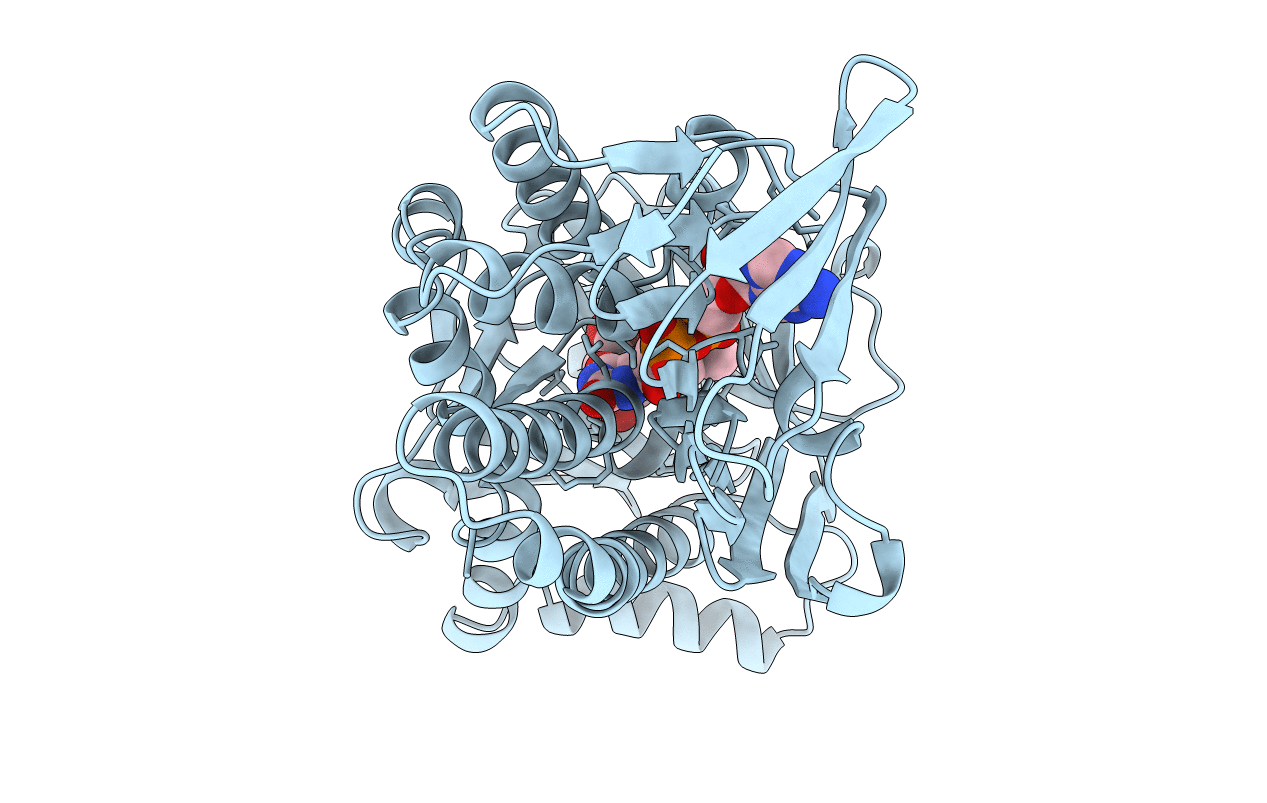
1BF3 image
Deposition Date 1998-05-26
Release Date 1998-08-12
Last Version Date 2024-05-22
Entry Detail
PDB ID:
1BF3
Keywords:
Title:
P-HYDROXYBENZOATE HYDROXYLASE (PHBH) MUTANT WITH CYS 116 REPLACED BY SER (C116S) AND ARG 42 REPLACED BY LYS (R42K), IN COMPLEX WITH FAD AND 4-HYDROXYBENZOIC ACID
Biological Source:
Source Organism(s):
Expression System(s):
Method Details:
Experimental Method:
Resolution:
2.20 Å
R-Value Work:
0.17
Space Group:
C 2 2 21
Macromolecular Entities
Structures with similar UniProt ID
Protein Blast
Polymer Type:polypeptide(L)
Molecule:P-HYDROXYBENZOATE HYDROXYLASE
Gene (Uniprot):pobA
Mutagens:R42K, C116S
Chain IDs:A
Chain Length:394
Number of Molecules:1
Biological Source:Pseudomonas fluorescens
Primary Citation
Lys42 and Ser42 variants of p-hydroxybenzoate hydroxylase from Pseudomonas fluorescens reveal that Arg42 is essential for NADPH binding.
Eur. J. Biochem. 253 194 201 (1998)
PMID: 9578477 DOI: 10.1046/j.1432-1327.1998.2530194.x

Abstact

The conserved Arg42 of the flavoprotein p-hydroxybenzoate hydroxylase is located at the entrance of the active site in a loop between helix H2 and sheet E1 of the FAD-binding domain. Replacement of Arg42 by Lys or Ser decreases the turnover rate of p-hydroxybenzoate hydroxylase from Pseudomonas fluorescens by more than two orders of magnitude. Rapid reaction kinetics show that the low activity of the Arg42 variants results from impaired binding of NADPH. In contrast to an earlier conclusion drawn for p-hydroxybenzoate hydroxylase from Acinetobacter calcoaceticus, substitution of Arg42 with Ser42 in the enzyme from P. fluorescens hardly disturbs the binding of FAD. Crystals of [Lys42]p-hydroxybenzoate hydroxylase complexed with 4-hydroxybenzoate diffract to 0.22-nm resolution. The structure of the Lys42 variant is virtually indistinguishable from the native enzyme with the flavin ring occupying the interior position within the active site. Lys42 in the mutant structure interacts indirectly via a solvent molecule with the 3-OH of the adenosine ribose moiety of FAD. Substrate perturbation difference spectra suggest that the Arg42 replacements influence the solvent accessibility of the flavin ring in the oxidized enzyme. In spite of this, the Arg42 variants fully couple enzyme reduction to substrate hydroxylation. Sequence-comparison studies suggest that Arg42 is involved in binding of the 2'-phosphoadenosine moiety of NADPH.

Legend

Protein

Chemical

Disease

Primary Citation of related structures
Feedback Form
Name
Email
Institute
Feedback