Abstact
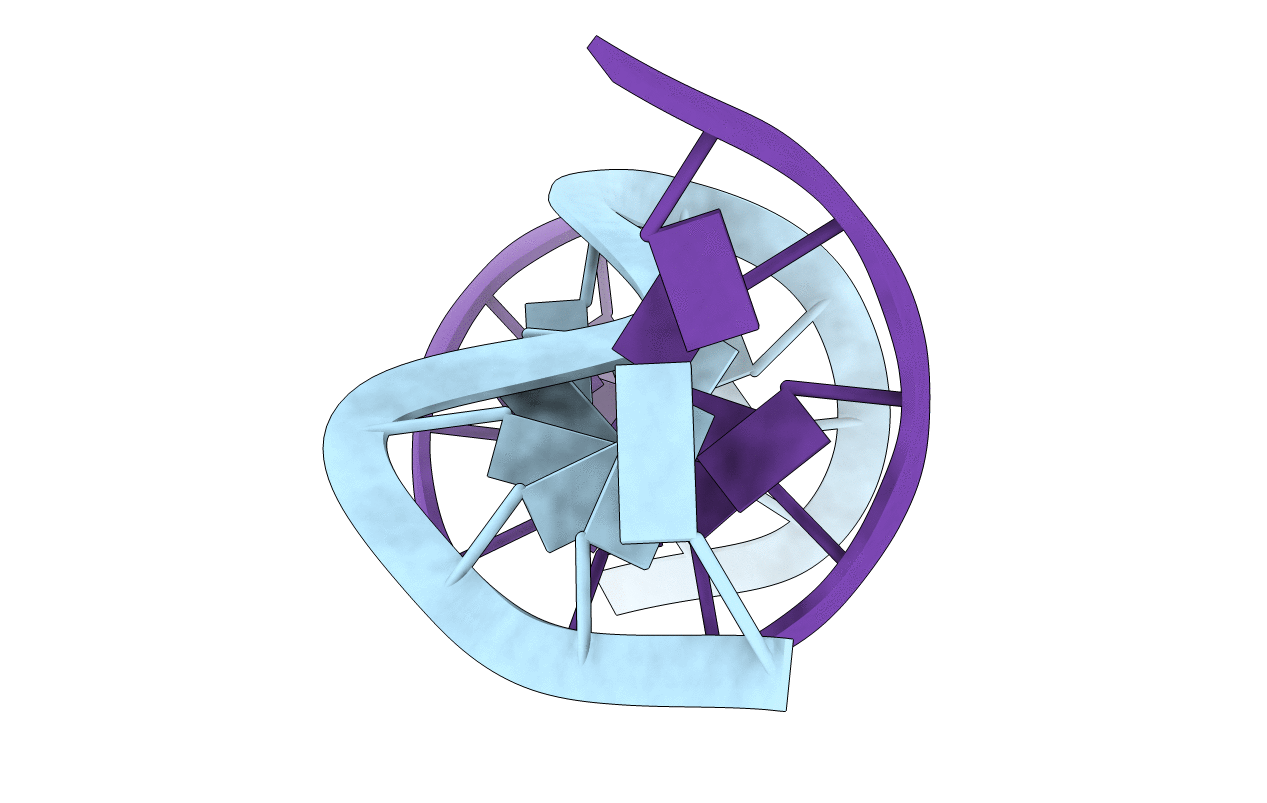
The (S)-alpha-(N6-adenyl)styrene oxide adducts at positions X6 in d(CGGACXAGAAG). d(CTTCTTGTCCG) and X7 in d(CGGACAXGAAG).d(CTTCTTGTCCG), incorporating codons 60, 61 (underlined), and 62 of the human n-ras protooncogene, were examined by 1H NMR. These were the S(61,2) and S(61,3) adducts. Chemical shift perturbations were in the 3'-direction from the sites of adduction; upfield changes associated with the styrene aromatic ring current were noted for S-SOA6 H2 and H1', T16 N3H, H6, and CH3 resonances in the S(61,2) oligomer. In the S(61,3) oligomer, S-SOA7 H1', T16 H1', C15 N4Ha, and H5 shifted upfield. The styrene aromatic rings flipped rapidly on the NMR time scale; under these conditions the ortho and meta aromatic protons were equivalent. A sequence effect, in which the S(61,2) adduct equilibrated between two conformers, while the S(61,3) adduct exhibited only a single conformation, was observed. Potential energy minimization of the S(61,2) adduct major conformation yielded a structure in which the styrene ring was oriented in the 3'-direction and interacted primarily with the complementary strand. For the S(61,3) adduct, 291 restraints were obtained from NOE data at three mixing times using relaxation matrix analysis. The emergent structures refined to an average rms difference of 1.3 A, determined by pairwise analysis. These were compared to NOE intensity data; the calculated sixth root residual index was 9.2 x 10⁻² at 250 ms. In the refined structure, the styrene ring was also oriented in the 3'-direction and interacted with the complementary strand. The minor conformation of the S(61,2) adduct was not identified. These results contrasted with the diastereomeric R(61,2) and R(61,3) adducts, which underwent slow ring flips on the NMR time scale and for which small sequence effects involving the minimum energy conformation of the styrene ring were observed.