

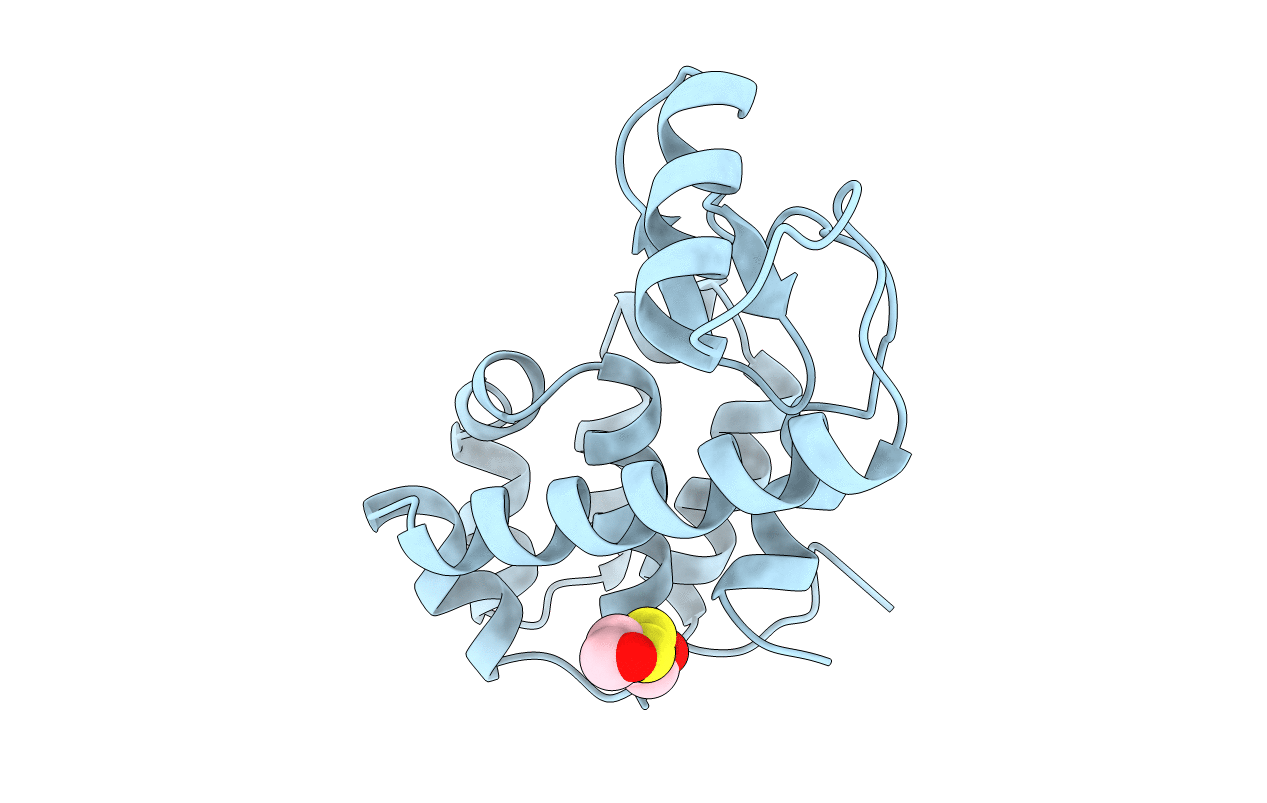
199L image
Deposition Date 1995-11-06
Release Date 1996-03-08
Last Version Date 2024-02-07
Entry Detail
PDB ID:
199L
Title:
THERMODYNAMIC AND STRUCTURAL COMPENSATION IN "SIZE-SWITCH" CORE-REPACKING VARIANTS OF T4 LYSOZYME
Biological Source:
Source Organism(s):
Expression System(s):
Method Details:
Experimental Method:
Resolution:
1.85 Å
R-Value Observed:
0.16
Space Group:
P 32 2 1
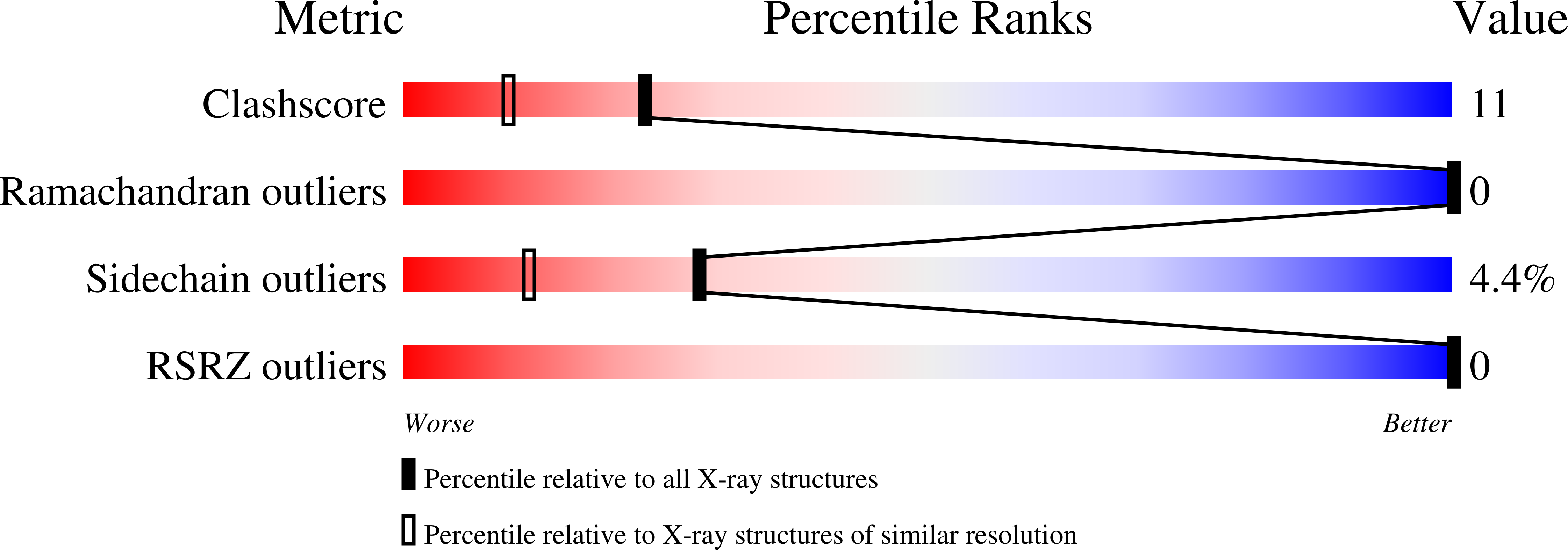
Macromolecular Entities
Structures with similar UniProt ID
Protein Blast
Polymer Type:polypeptide(L)
Molecule:LYSOZYME
Gene (Uniprot):E
Mutagens:C54T, C97A, L121A, A129M
Chain IDs:A
Chain Length:164
Number of Molecules:1
Biological Source:Enterobacteria phage T4
Primary Citation
Thermodynamic and structural compensation in "size-switch" core repacking variants of bacteriophage T4 lysozyme.
J.Mol.Biol. 259 542 559 (1996)
PMID: 8676387 DOI: 10.1006/jmbi.1996.0338

Abstact

Previous analysis of randomly generated multiple mutations within the core of bacteriophage T4 lysozyme suggested that the "large-to-small" substitution Leu121 to Ala (L121A) and the spatially adjacent "small-to-large" substitution Ala129 to Met (A129M) might be mutually compensating. To test this hypothesis, the individual variants L121A and A129M were generated, as well as the double "size-switch" mutant L121A/A129M. To make the interchange symmetrical, the combination of L121A with A129L to give L121A/A129L was also constructed. The single mutations were all destabilizing. Somewhat surprisingly, the small-to-large substitutions, which increase hydrophobic stabilization but can also introduce strain, were less deleterious than the large-to-small replacements. Both Ala129 --> Leu and Ala129 --> Met offset the destabilization of L121A by about 50%. Also, in contrast to typical Leu --> Ala core substitutions, which destabilize by 2 to 5 kcal/mol, Leu121 --> Ala slightly stabilized A129L and A129M. Crystal structure analysis showed that a combination of side-chain and backbone adjustments partially accommodated changes in side-chain volume, but only to a limited degree. For example, the cavity that was created by the Leu121 to Ala replacement actually became larger in L121A/A129L. The results demonstrate that the destabilization associated with a change in volume of one core residue can be specifically compensated by an offsetting volume change in an adjacent residue. It appears, however, that complete compensation is unlikely because it is difficult to reconstitute an equivalent set of interactions. The relatively slow evolution of core relative to surface residues appears, therefore, to be due to two factors. First, a mutation in a single core residue that results in a substantial change in size will normally lead to a significant loss in stability. Such mutations will presumably be selected against. Second, if a change in bulk does occur in a buried residue, it cannot normally be fully compensated by a mutation of an adjacent residue. Thus, the most probable response will tend to be reversion to the parent protein.

Legend

Protein

Chemical

Disease

Primary Citation of related structures
Feedback Form
Name
Email
Institute
Feedback