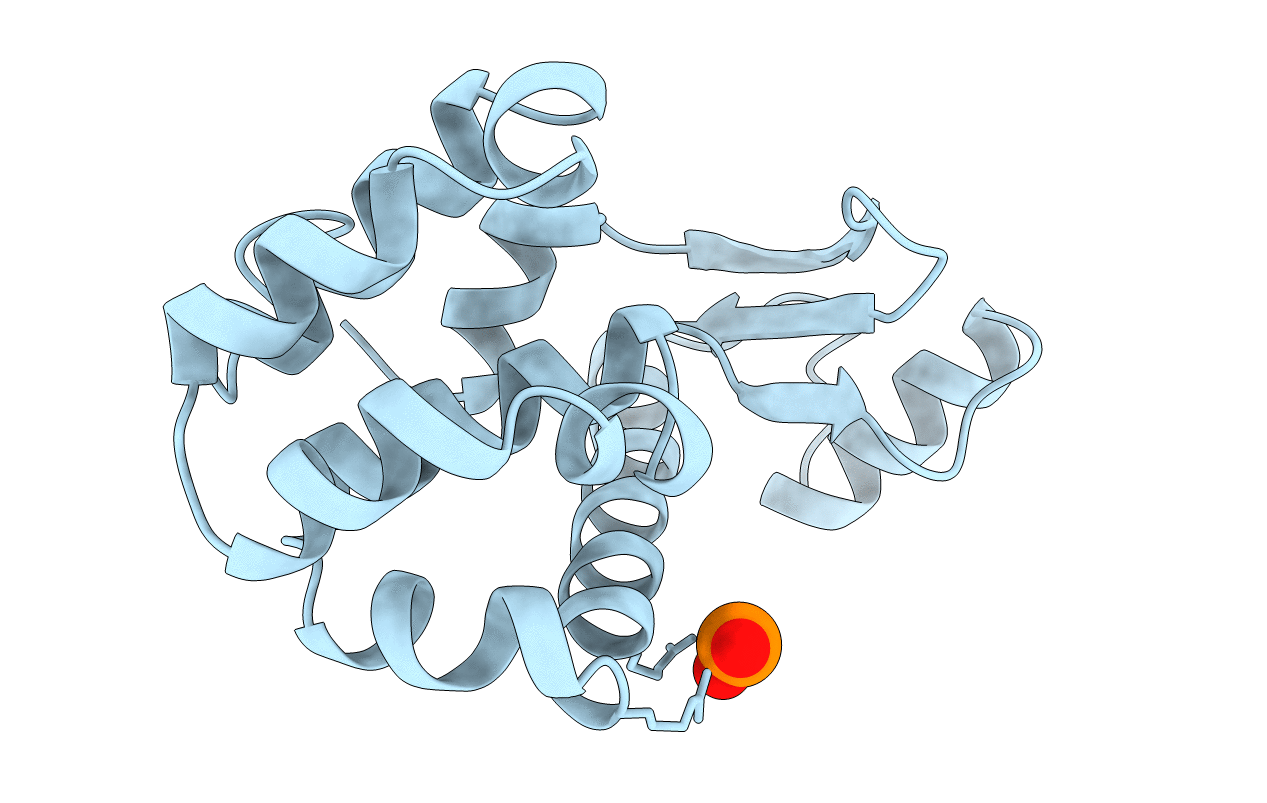
151L image
Deposition Date 1994-01-25
Release Date 1994-04-30
Last Version Date 2024-02-07
Entry Detail
PDB ID:
151L
Title:
CONSERVATION OF SOLVENT-BINDING SITES IN 10 CRYSTAL FORMS OF T4 LYSOZYME
Biological Source:
Source Organism(s):
Method Details:
Experimental Method:
Resolution:
2.20 Å
R-Value Observed:
0.18
Space Group:
H 3
Macromolecular Entities
Structures with similar UniProt ID
Protein Blast
Polymer Type:polypeptide(L)
Molecule:T4 LYSOZYME
Gene (Uniprot):E
Chain IDs:A
Chain Length:164
Number of Molecules:1
Biological Source:Enterobacteria phage T4
Ligand Molecules
Primary Citation
Conservation of solvent-binding sites in 10 crystal forms of T4 lysozyme.
Protein Sci. 3 1031 1039 (1994)
PMID: 7920248

Abstact

Solvent-binding sites were compared in 10 different crystal forms of phage T4 lysozyme that were refined using data from 2.6 A to 1.7 A resolution. The sample included 18 crystallographically independent lysozyme molecules. Despite different crystallization conditions, variable crystal contacts, changes due to mutation, and varying attention to solvent during crystallographic refinement, 62% of the 20 most frequently occupied sites were conserved. Allowing for potential steric interference from neighboring molecules in the crystal lattice, this fraction increased to 79% of the sites. There was, however, no solvent-binding site that was occupied in all 18 lysozyme molecules. A buried double site was occupied in 17 instances and 2 other internal sites were occupied 15 times. Apart from these buried sites, the most frequently occupied sites were often at the amino-termini of alpha-helices. Solvent molecules at the most conserved sites tended to have crystallographic thermal factors lower than average, but atoms with low B-factors were not restricted to these sites. Although superficial inspection may suggest that only 50-60% (or less) of solvent-binding sites are conserved in different crystal forms of a protein, it appears that many sites appear to be empty either because of steric interference or because the apparent occupancy of a given site can vary from crystal to crystal. The X-ray method of identifying sites is somewhat subjective and tends to result in specification only of those solvent molecules that are well ordered and bound with high occupancy, even though there is clear evidence for solvent bound at many additional sites.(ABSTRACT TRUNCATED AT 250 WORDS)

Legend

Protein

Chemical

Disease

Primary Citation of related structures
Feedback Form
Name
Email
Institute
Feedback