

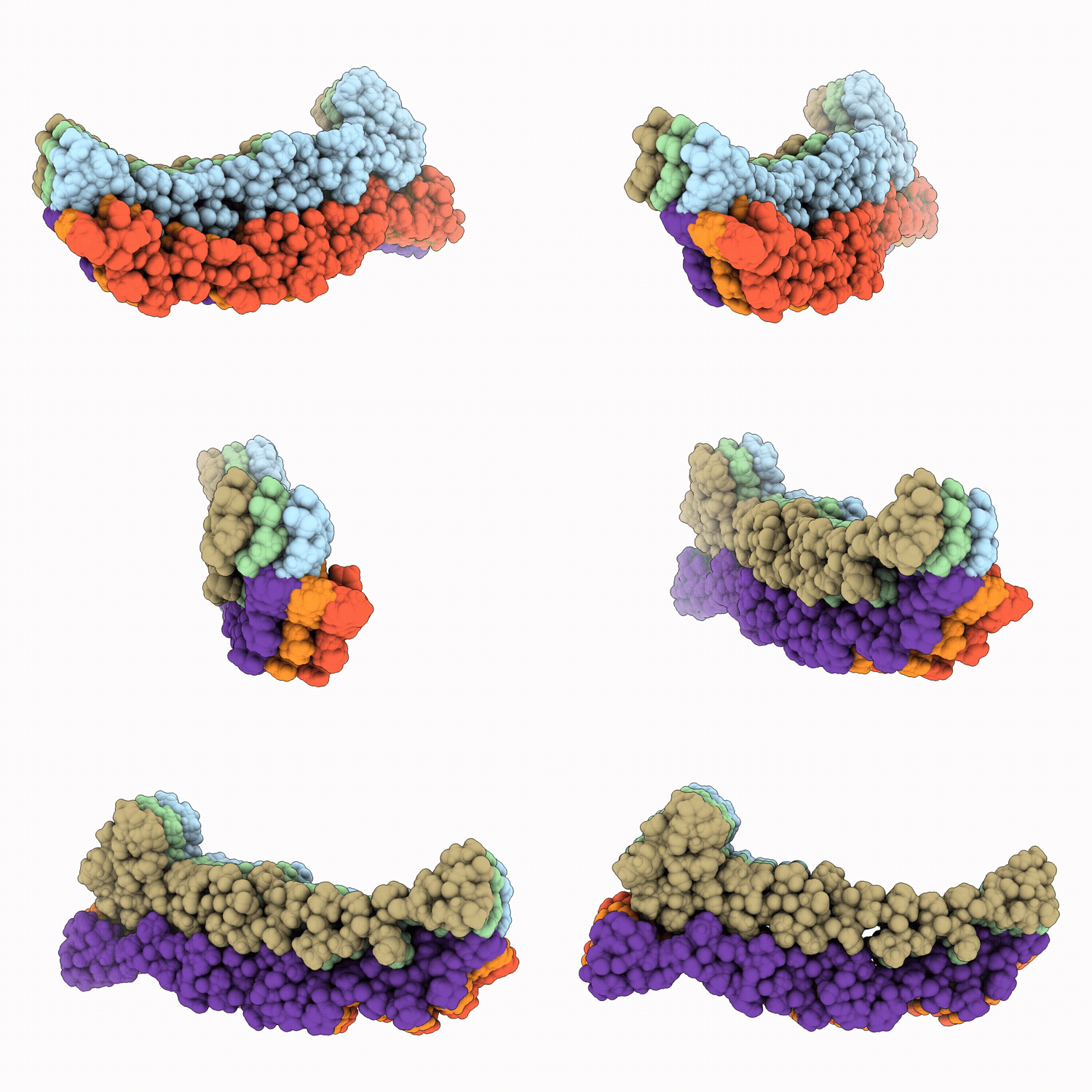
11EP image
Deposition Date 2026-02-19
Release Date 2026-05-20
Last Version Date 2026-05-20
Entry Detail
PDB ID:
11EP
Keywords:
Title:
Structure of Rapidly twisting Amyloid-beta 40 fibril , RT-Ab40(C1)
Biological Source:
Source Organism(s):
Homo sapiens (Taxon ID: 9606)
Method Details:
Experimental Method:
Resolution:
2.75 Å
Aggregation State:
FILAMENT
Reconstruction Method:
HELICAL
Macromolecular Entities
Structures with similar UniProt ID
Protein Blast
Polymer Type:polypeptide(L)
Molecule:RT-Ab40(C1)
Gene (Uniprot):APP
Chain IDs:A, B, C, D, E, F
Chain Length:40
Number of Molecules:6
Biological Source:Homo sapiens
Ligand Molecules
Primary Citation
Polymorphic structures of rapidly twisting 40-residue amyloid-beta fibrils.
Biorxiv ? ? ? (2026)
PMID: 42039599 DOI: 10.64898/2026.04.10.717728

Abstact

Fibrils formed by 40- and 42-residue amyloid-beta peptides (Abeta40 and Abeta42) are polymorphic, containing molecular structures that vary with growth conditions in ways that are not fully understood. Here we use cryogenic electron microscopy to characterize the structure of rapidly twisting Abeta40 fibrils, for which the distance between apparent width minima in electron microscope images ("cross-over distances") is approximately 25 nm. From samples grown under a single set of growth conditions, we obtain high-resolution structures for three different rapidly twisting polymorphs. Although their cross-over distances are similar, the three rapidly twisting polymorphs differ in twist handedness, symmetry, molecular conformations, and intermolecular contacts. Two of the rapidly twisting polymorphs resemble slowly twisting Abeta40 polymorphs that have been described previously, including polymorphs extracted from brain tissue of Alzheimer's disease patients or created by seeded growth from amyloid in brain tissue, but with shorter conformationally ordered segments and other specific conformational differences. These results contribute to our understanding of amyloid polymorphism, connections between morphology and molecular structure, and relationships between brain-derived and in vitro-grown fibrils.

Legend

Protein

Chemical

Disease

Primary Citation of related structures
Feedback Form
Name
Email
Institute
Feedback