

9XZI image
Deposition Date 2025-08-27
Release Date 2026-02-11
Last Version Date 2026-02-25
Entry Detail
PDB ID:
9XZI
Keywords:
Title:
Crystal Structure of the SUZ12-RBBP4-PHF19-EPOP PRC2.1 Subcomplex
Biological Source:
Source Organism(s):
Homo sapiens (Taxon ID: 9606)
Expression System(s):
Method Details:
Experimental Method:
Resolution:
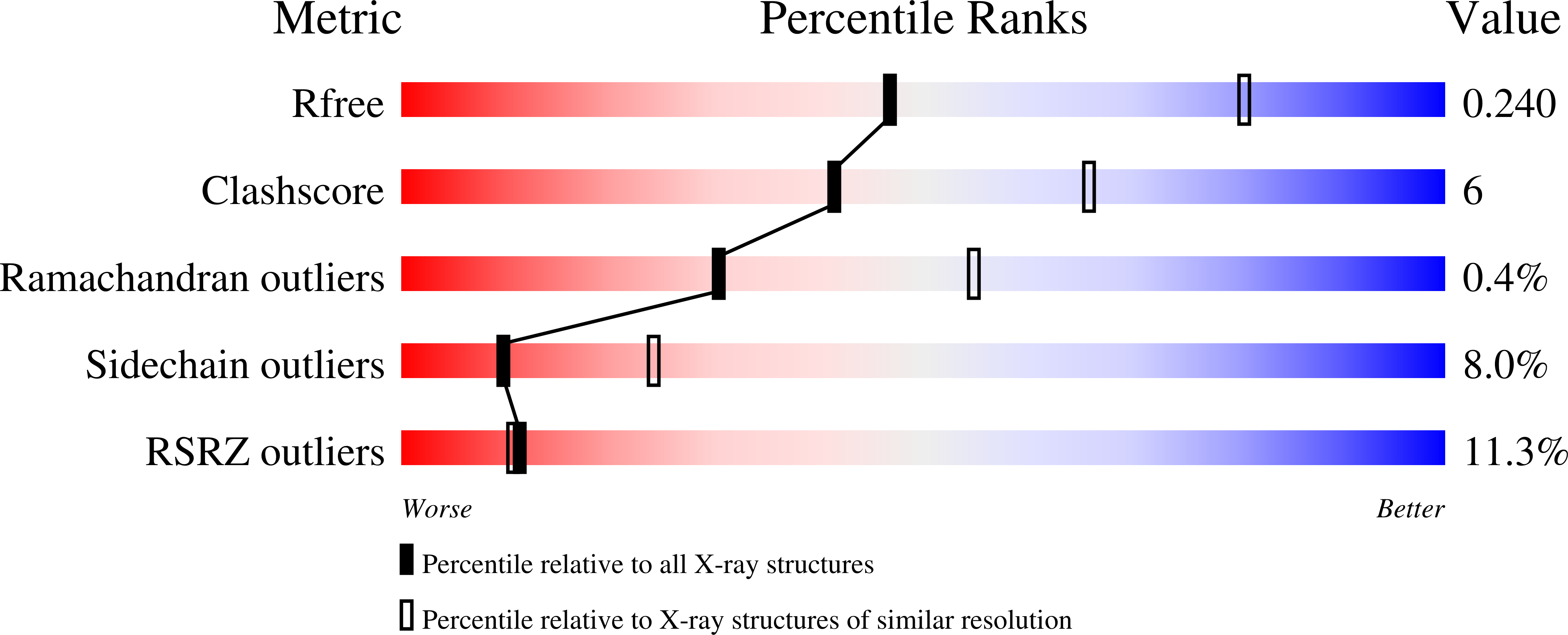
2.69 Å
R-Value Free:
0.25
R-Value Work:
0.20
R-Value Observed:
0.21
Space Group:
H 3 2
Macromolecular Entities
Structures with similar UniProt ID
Protein Blast
Polymer Type:polypeptide(L)
Molecule:Polycomb protein SUZ12
Gene (Uniprot):SUZ12
Chain IDs:A
Chain Length:473
Number of Molecules:1
Biological Source:Homo sapiens
Structures with similar UniProt ID
Protein Blast
Polymer Type:polypeptide(L)
Molecule:Histone-binding protein RBBP4
Gene (Uniprot):RBBP4
Chain IDs:B
Chain Length:444
Number of Molecules:1
Biological Source:Homo sapiens
Structures with similar UniProt ID
Protein Blast
Polymer Type:polypeptide(L)
Molecule:PHD finger protein 19
Gene (Uniprot):PHF19
Chain IDs:C
Chain Length:53
Number of Molecules:1
Biological Source:Homo sapiens
Structures with similar UniProt ID
Protein Blast
Polymer Type:polypeptide(L)
Molecule:Elongin BC and Polycomb repre
Gene (Uniprot):EPOP
Chain IDs:D
Chain Length:78
Number of Molecules:1
Biological Source:Homo sapiens
Ligand Molecules
Primary Citation
EPOP restricts PRC2.1 targeting to chromatin by directly modulating enzyme complex dimerization.
Nat Commun 17 1565 1565 (2026)
PMID: 41519789 DOI: 10.1038/s41467-025-68280-5

Abstact

Polycomb repressive complex 2 (PRC2) mediates developmental gene repression as two classes of holocomplexes, PRC2.1 and PRC2.2. EPOP is an accessory subunit specific to PRC2.1, which also contains PCL proteins. Unlike other accessory subunits that collectively facilitate PRC2 targeting, EPOP was implicated in an enigmatic inhibitory role, together with its interactor Elongin BC. We report an unusual molecular mechanism whereby EPOP regulates PRC2.1 by directly modulating its oligomerization state. EPOP disrupts the PRC2.1 dimer and weakens its chromatin association, likely by disabling the avidity effect conferred by the dimeric complex. Congruently, an EPOP mutant specifically defective in PRC2 binding enhances genome-wide enrichments of MTF2 in mouse epiblast-like cells. Elongin BC is largely dispensable for the EPOP-mediated inhibition of PRC2.1. EPOP defines a distinct subclass of PRC2.1, which may uniquely maintain an epigenetic program by preventing the over-repression of key gene regulators along the continuum of early differentiation.

Legend

Protein

Chemical

Disease

Primary Citation of related structures
Feedback Form
Name
Email
Institute
Feedback