

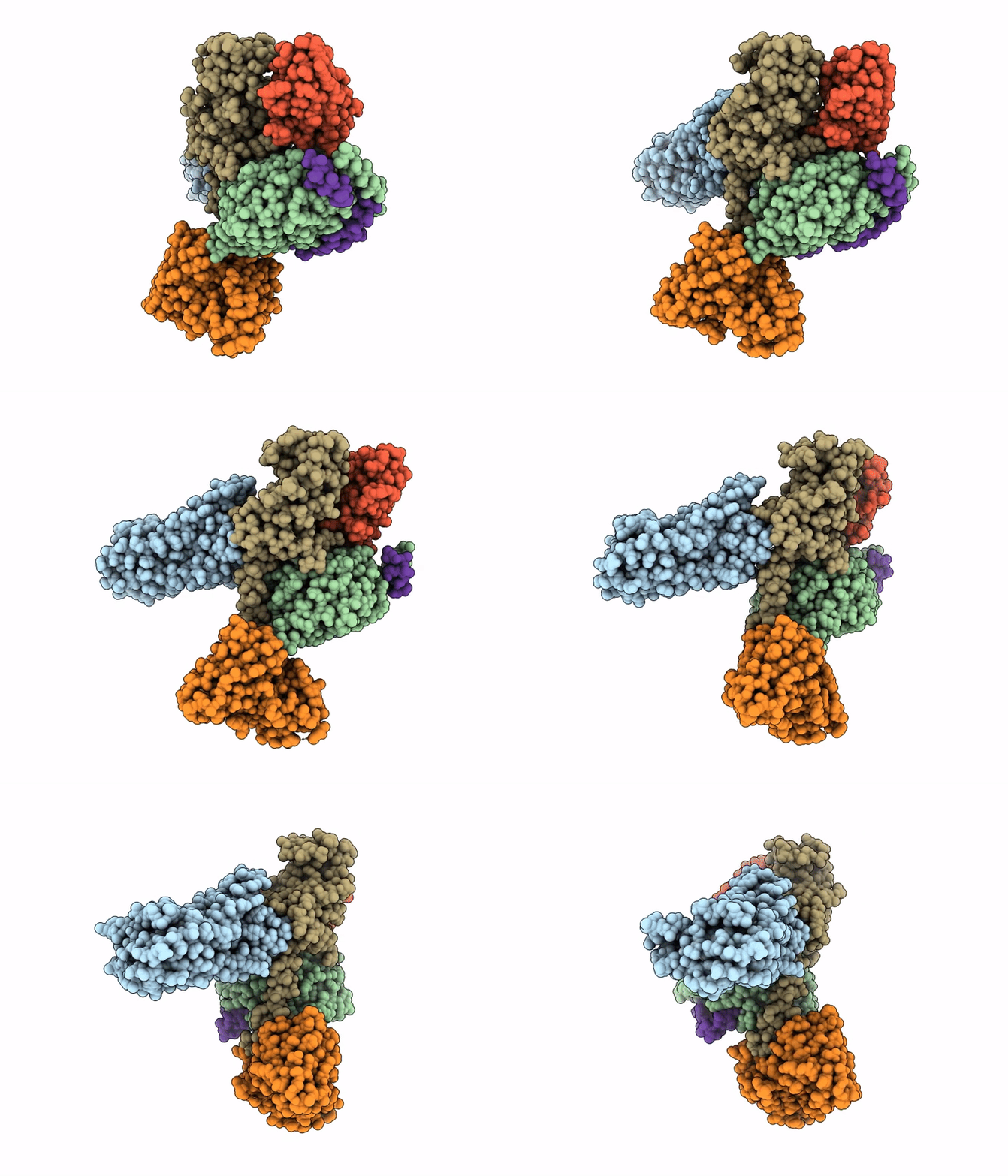
9WPM image
Deposition Date 2025-09-09
Release Date 2026-01-28
Last Version Date 2026-03-18
Entry Detail
PDB ID:
9WPM
Title:
Cryo-EM structure of the apo-ConsOR5-Gs complex
Biological Source:
Source Organism(s):
Expression System(s):
Method Details:
Experimental Method:
Resolution:
2.60 Å
Aggregation State:
PARTICLE
Reconstruction Method:
SINGLE PARTICLE

Macromolecular Entities
Polymer Type:polypeptide(L)
Molecule:Consensus OR5 Olfactory recep
Chain IDs:A
Chain Length:310
Number of Molecules:1
Biological Source:synthetic construct
Structures with similar UniProt ID
Protein Blast
Polymer Type:polypeptide(L)
Molecule:Guanine nucleotide-binding pr
Gene (Uniprot):GNB1
Chain IDs:D (auth: B)
Chain Length:345
Number of Molecules:1
Biological Source:Homo sapiens
Polymer Type:polypeptide(L)
Molecule:Guanine nucleotide-binding pr
Chain IDs:B (auth: C)
Chain Length:362
Number of Molecules:1
Biological Source:Homo sapiens
Polymer Type:polypeptide(L)
Molecule:Nanobody-35
Chain IDs:C (auth: N)
Chain Length:128
Number of Molecules:1
Biological Source:synthetic construct
Polymer Type:polypeptide(L)
Molecule:scFv16
Chain IDs:F (auth: S)
Chain Length:285
Number of Molecules:1
Biological Source:synthetic construct
Structures with similar UniProt ID
Protein Blast
Polymer Type:polypeptide(L)
Molecule:Guanine nucleotide-binding pr
Gene (Uniprot):GNG2
Chain IDs:E (auth: Y)
Chain Length:71
Number of Molecules:1
Biological Source:Homo sapiens
Ligand Molecules
Primary Citation
Mechanistic insights into fatty acid odor detection mediated by class II olfactory receptors.
Cell 189 1465 1480.e19 (2026)
PMID: 41570821 DOI: 10.1016/j.cell.2025.12.018

Abstact

Smell is one of the fundamental senses mediated by thousands of odorant receptors (ORs). How hydrophobic and volatile odor molecules are recognized by class II ORs remains elusive. Here, we present cryo-electron microscopy (cryo-EM) structures of class II OR Olfr110 complexed with the unsaturated fatty acid metabolite (UFAM) PL45, Gs, and cons-OR5. The structural study revealed an unusually large hydrophobic pocket accommodating PL45 and the endogenous agonist 12(S)-hydroxyeicosapentaenoic acid (12(S)-HEPE). This pocket is decorated with polar residues and aromatic residue arrays, constituting polar networks and π-π interactions with the natural agonist PL45, respectively. Conserved motifs in the type II OR5 subfamily responsible for ligand recognition are characterized. The inward movement of extracellular loop 3 (ECL3) and an unconventional activation mechanism underlie Olfr110 activation. At the G protein interface, Olfr110 displays common and unique interactions. Overall, we revealed the structural basis of odor recognition and the activation mechanism of class II ORs, which may facilitate drug development targeting these receptors.

Legend

Protein

Chemical

Disease

Primary Citation of related structures
Feedback Form
Name
Email
Institute
Feedback