

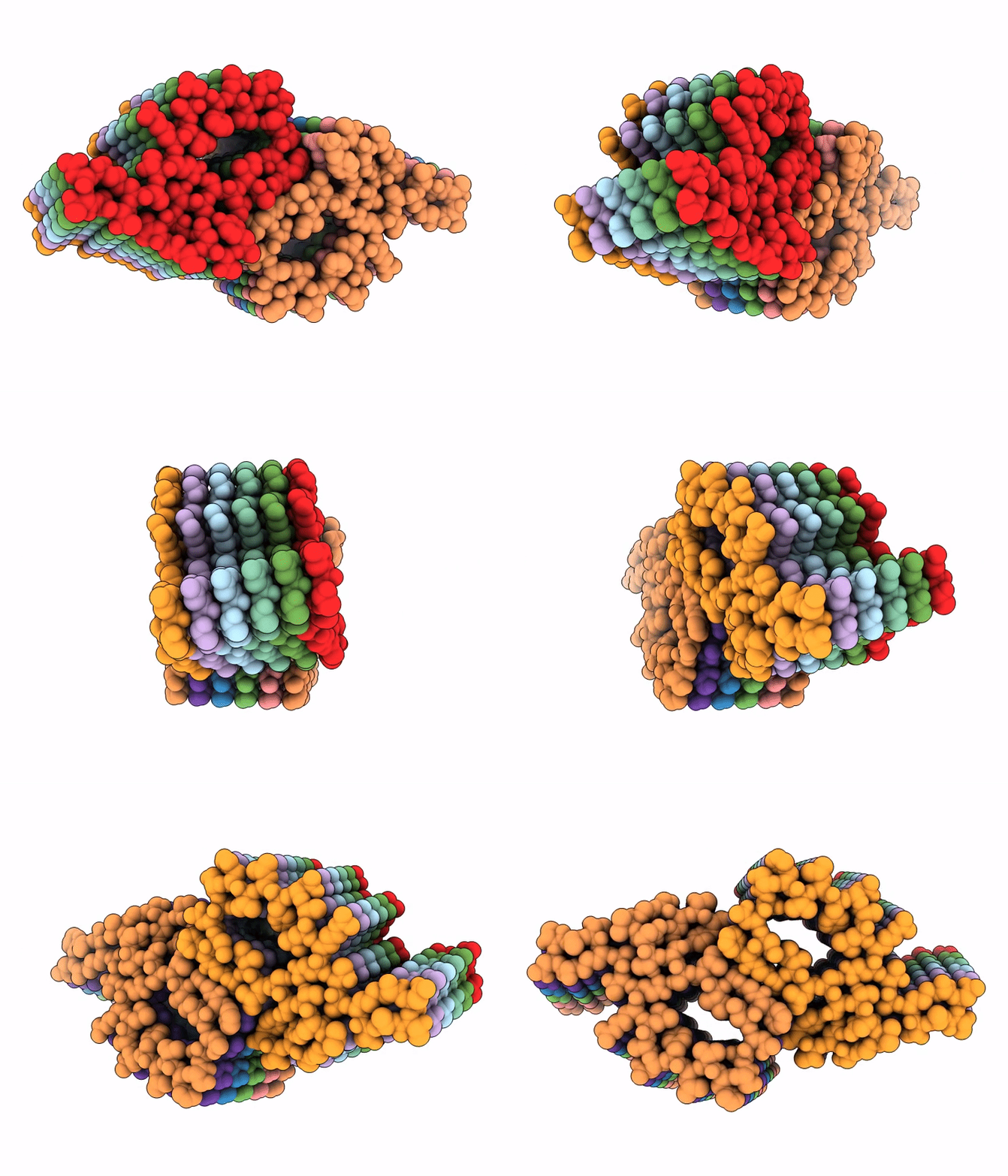
9ULZ image
Deposition Date 2025-04-21
Release Date 2026-01-14
Last Version Date 2026-03-11
Entry Detail
PDB ID:
9ULZ
Keywords:
Title:
Cryo-EM structure of hIAPP fibrils extracted from a donor with T2D and pancreatic cancer
Biological Source:
Source Organism(s):
Homo sapiens (Taxon ID: 9606)
Method Details:
Experimental Method:
Resolution:
2.90 Å
Aggregation State:
FILAMENT
Reconstruction Method:
HELICAL
Macromolecular Entities
Structures with similar UniProt ID
Protein Blast
Polymer Type:polypeptide(L)
Molecule:Islet amyloid polypeptide
Gene (Uniprot):IAPP
Chain IDs:A, B, C, D, E, F, G, H, I, J, K, L
Chain Length:37
Number of Molecules:12
Biological Source:Homo sapiens
Ligand Molecules
Primary Citation
Structure of pancreatic hIAPP fibrils derived from patients with type 2 diabetes.
Cell 189 1201 ? (2026)
PMID: 41483806 DOI: 10.1016/j.cell.2025.12.001

Abstact

Type 2 diabetes (T2D) impacts the quality of life and lifespan of nearly 10% of the global population. Human islet amyloid polypeptide (hIAPP) constitutes a major component of islet amyloid deposition in patients with T2D, with hIAPP fibrils believed to play a key role in the pathogenesis of T2D. In this study, we determined the cryo-electron microscopy (cryo-EM) structure of hIAPP fibrils extracted from surgically resected pancreases of three donors with T2D. These fibrils exhibit a uniform morphology, comprising two symmetrical protofilaments encompassing residues 2-37 of hIAPP and adopting an Ω-shaped fold. The structure of pancreatic hIAPP fibrils differs from that of fibrils formed in vitro. Additional densities were observed in the pancreatic hIAPP fibrils, suggesting ligand binding that may play significant roles in the pathogenesis of T2D. Collectively, our study presents the atomic structure of pathological hIAPP fibrils, contributing to the therapeutic and mechanistic exploration of T2D.

Legend

Protein

Chemical

Disease

Primary Citation of related structures
Feedback Form
Name
Email
Institute
Feedback