

9PDP image
Deposition Date 2025-06-30
Release Date 2026-02-04
Last Version Date 2026-02-11
Entry Detail
PDB ID:
9PDP
Keywords:
Title:
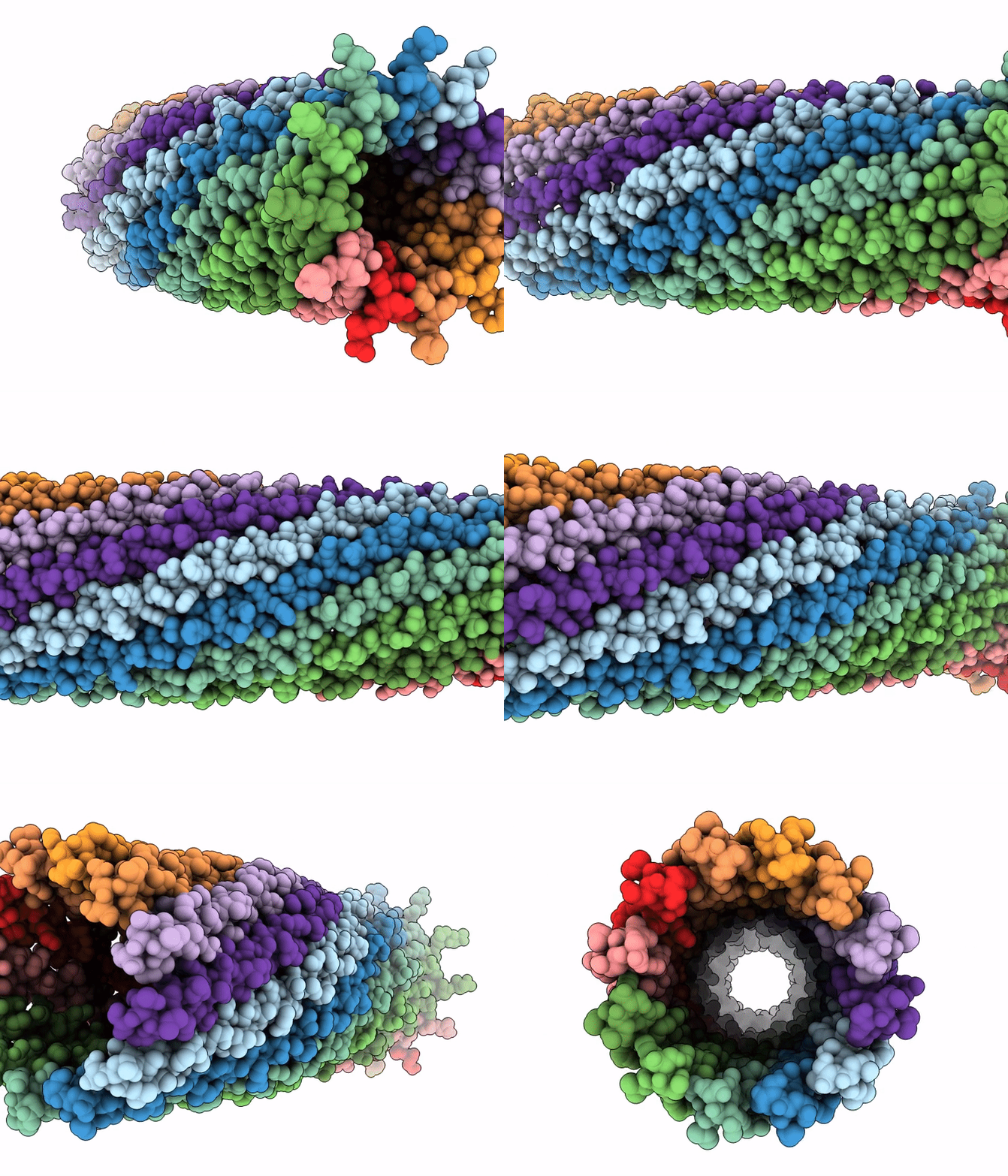
In situ cryoEM structure of bacteriophage P22 portal barrel
Biological Source:
Source Organism(s):
Method Details:
Experimental Method:
Resolution:
3.83 Å
Aggregation State:
PARTICLE
Reconstruction Method:
SINGLE PARTICLE
Macromolecular Entities
Structures with similar UniProt ID
Protein Blast
Polymer Type:polypeptide(L)
Molecule:Portal protein
Gene (Uniprot):1
Chain IDs:A, B, C, D, E, F, G, H, I, J, K, L
Chain Length:109
Number of Molecules:12
Biological Source:Lederbergvirus P22
Ligand Molecules
Primary Citation
Structural Basis for Bacteriophage P22 Assembly and Infection Initiation.
J.Mol.Biol. 438 169647 169647 (2026)
PMID: 41565001 DOI: 10.1016/j.jmb.2026.169647

Abstact

Salmonella phage P22 deploys a highly coordinated tail machine to recognize hosts and initiate infection. Here, we present a cryo-EM structure of wild-type P22 that defines how the tail apparatus assembles onto the capsid and how they interface. Flexible loop residues on both the portal protein gp1 and the capsid protein gp5 undergo pronounced positional shifts and engage multiple partners to accommodate the C12-C5 symmetry mismatch at the portal-capsid interface. The portal protein gp1 forms a distinctive ∼15-nm barrel that projects deep into the capsid interior. Comparison with a mutant lacking the three internal E (ejection) proteins indicates that these proteins reside within the portal-tail lumen in a poorly ordered state, yet are essential for stabilizing the extended portal barrel. We further show how the hub protein gp10 orchestrates the assembly of four distinct particle isomers through its coordinated interactions with portal gp1, adaptor gp4, tailspike gp9, and needle gp26. Finally, cryo-electron tomography reveals that the gp10 hub acts as a structural foundation for the assembly of one E protein into an extracellular channel that breaches the cell surface, with other E proteins forming a genome-translocating trans-envelope conduit.

Legend

Protein

Chemical

Disease

Primary Citation of related structures
Feedback Form
Name
Email
Institute
Feedback