

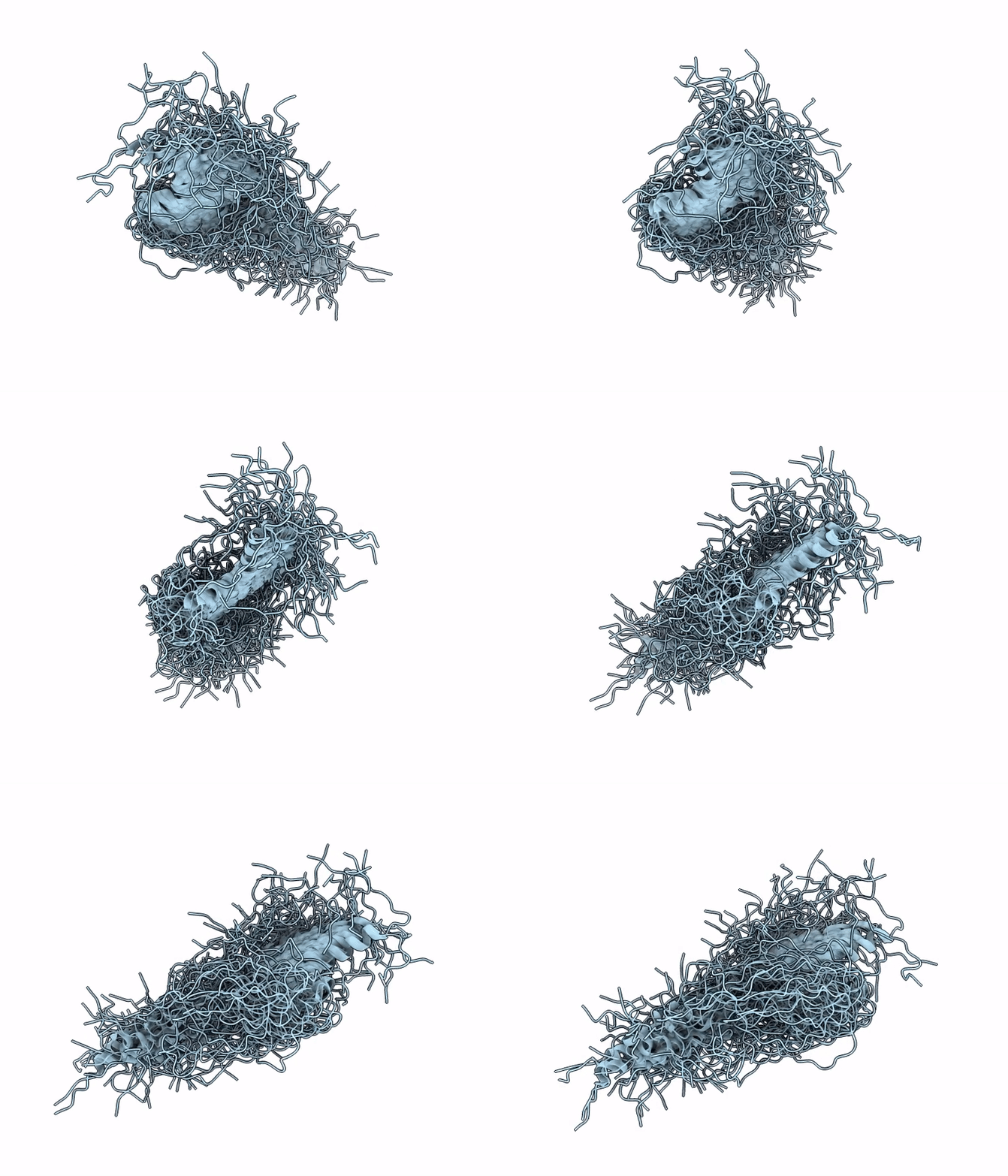
9M2D image
Deposition Date 2025-02-27
Release Date 2026-01-14
Last Version Date 2026-02-18
Entry Detail
PDB ID:
9M2D
Keywords:
Title:
SERF1_HUMAN short isoform of Small EDRK-rich factor 1, serf1a at pH 6.8.
Biological Source:
Source Organism(s):
Homo sapiens (Taxon ID: 9606)
Expression System(s):
Method Details:
Experimental Method:
Conformers Calculated:
2000
Conformers Submitted:
100
Selection Criteria:
structures with the lowest energy

Macromolecular Entities
Structures with similar UniProt ID
Protein Blast
Polymer Type:polypeptide(L)
Molecule:Isoform Short of Small EDRK-r
Gene (Uniprot):SERF1A, SERF1B
Chain IDs:A
Chain Length:64
Number of Molecules:1
Biological Source:Homo sapiens
Ligand Molecules
Primary Citation
pH Sensitivity of the SERF1a Conformational Ensemble.
Acs Omega 11 2614 2627 (2026)
PMID: 41585721 DOI: 10.1021/acsomega.5c07620

Abstact

The MOAG-4/SERF class of proteins is a positive regulator of the aggregate formation of amyloid proteins that play an important role in the origin of numerous age-related diseases. In this class of proteins, previous structural studies showed that SERF1a is a very flexible protein, containing at least one α-helical region. The present work proposes the first description of the conformational space of SERF1a at two pH values (6 and 6.8) using nuclear magnetic resonance (NMR) and small-angle X-ray scattering (SAXS). SERF1a NMR conformations have been generated using the CYANA-FLYA procedure as well as the TAiBP (Threading-Augmented interval Branch-and-Prune) procedure, based on the systematic enumeration of protein conformations within an original distance geometry scheme. The generated conformations were filtered using Pepsi-SAXS by fitting small-angle X-ray experiments based on size exclusion chromatography (SEC-SAXS). At pH 6.8, a good fit of the SEC-SAXS curves was obtained for the CYANA and TAiBP NMR conformations, while at pH 6, analysis of the NMR conformations and the SEC-SAXS curves indicated that there could be a conformational exchange between a compact conformation displaying long-range nuclear Overhauser effects (NOEs) between residues LYS-13 and THR-32, and slightly more extended conformations. The shortening of the C-terminal α-helix, as well as the destabilization of the N-terminal α-helix at acidic pH, may be related to the physiological function of SERF1a in the nucleoli. Interestingly, the N-terminal region of SERF1a displays numerous possible binding pockets, particularly in the region interacting with α-synuclein, detected by chemical shift perturbations. In general, the TAiBP procedure allows for a more expanded exploration of the SERF1a conformational space as well as for a description of the internal dynamics of SERF1a in agreement with NMR relaxation and with predictions from the protein primary sequence.

Legend

Protein

Chemical

Disease

Primary Citation of related structures
Feedback Form
Name
Email
Institute
Feedback