

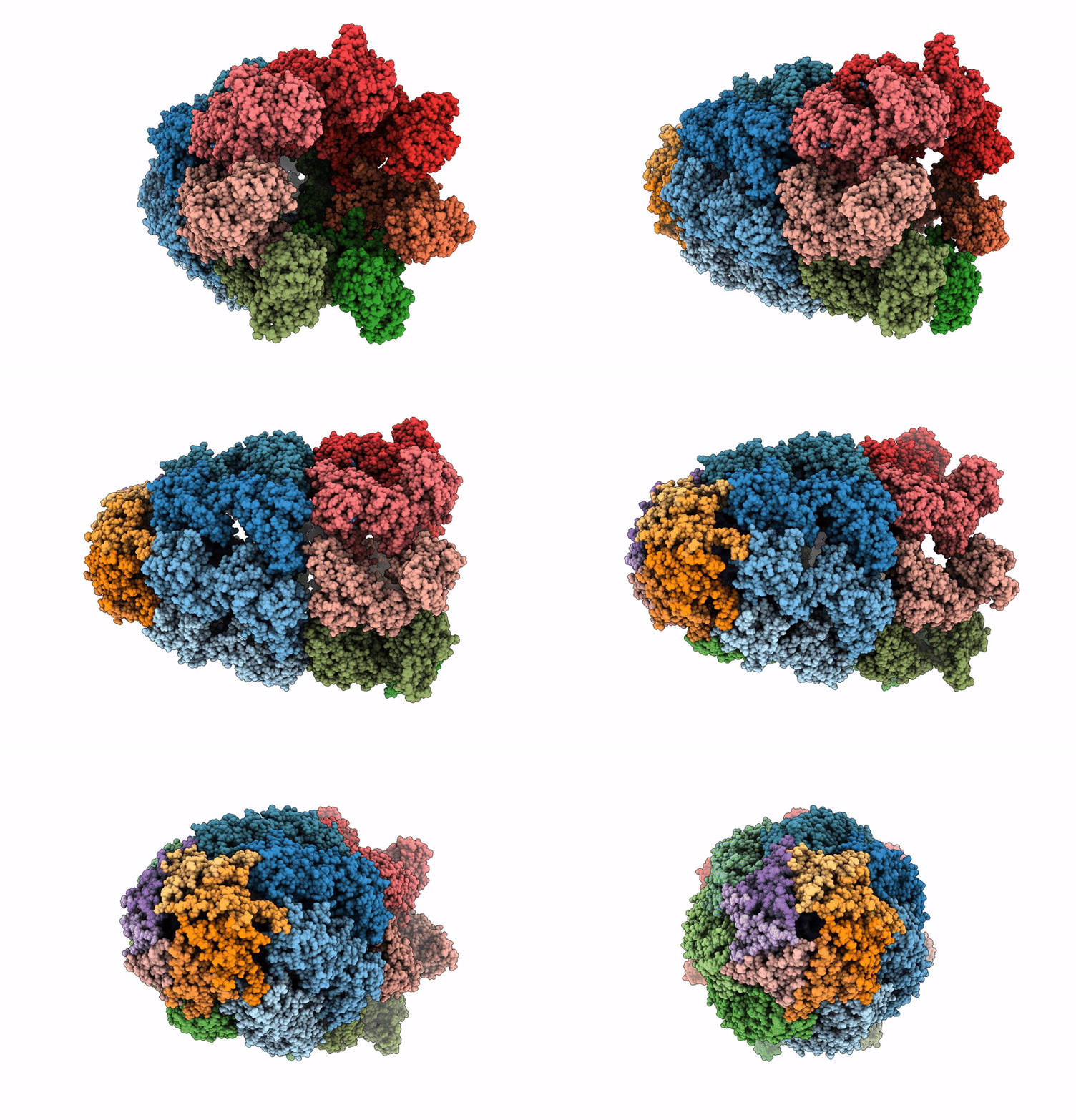
8BAA image
Deposition Date 2022-10-11
Release Date 2025-02-12
Last Version Date 2026-02-25
Entry Detail
PDB ID:
8BAA
Keywords:
Title:
CryoEM structure of GroEL-GroES-ADP.AlF3-Rubisco, class II.
Biological Source:
Method Details:
Experimental Method:
Resolution:
4.20 Å
Aggregation State:
PARTICLE
Reconstruction Method:
SINGLE PARTICLE
Macromolecular Entities
Structures with similar UniProt ID
Protein Blast
Polymer Type:polypeptide(L)
Molecule:Chaperonin GroEL
Gene (Uniprot):groEL
Chain IDs:A, B, C, D, E, F, G, H, I, J, K, L, M, N
Chain Length:547
Number of Molecules:14
Biological Source:Escherichia coli (strain K12)
Structures with similar UniProt ID
Protein Blast
Polymer Type:polypeptide(L)
Molecule:Co-chaperonin GroES
Gene (Uniprot):groES
Chain IDs:O, P, Q, R, S, T, U
Chain Length:97
Number of Molecules:7
Biological Source:Escherichia coli (strain K12)
Structures with similar UniProt ID
Protein Blast
Polymer Type:polypeptide(L)
Molecule:Ribulose bisphosphate carboxy
Gene (Uniprot):cbbM
Chain IDs:V (auth: Z)
Chain Length:466
Number of Molecules:1
Biological Source:Rhodospirillum rubrum (strain ATCC 11170 / ATH 1.1.1 / DSM 467 / LMG 4362 / NCIMB 8255 / S1)
Primary Citation
Structural basis of substrate progression through the bacterial chaperonin cycle.
Proc.Natl.Acad.Sci.USA 120 e2308933120 e2308933120 (2023)
PMID: 38064510 DOI: 10.1073/pnas.2308933120

Abstact

The bacterial chaperonin GroEL-GroES promotes protein folding through ATP-regulated cycles of substrate protein binding, encapsulation, and release. Here, we have used cryoEM to determine structures of GroEL, GroEL-ADP·BeF3, and GroEL-ADP·AlF3-GroES all complexed with the model substrate Rubisco. Our structures provide a series of snapshots that show how the conformation and interactions of non-native Rubisco change as it proceeds through the GroEL-GroES reaction cycle. We observe specific charged and hydrophobic GroEL residues forming strong initial contacts with non-native Rubisco. Binding of ATP or ADP·BeF3 to GroEL-Rubisco results in the formation of an intermediate GroEL complex displaying striking asymmetry in the ATP/ADP·BeF3-bound ring. In this ring, four GroEL subunits bind Rubisco and the other three are in the GroES-accepting conformation, suggesting how GroEL can recruit GroES without releasing bound substrate. Our cryoEM structures of stalled GroEL-ADP·AlF3-Rubisco-GroES complexes show Rubisco folding intermediates interacting with GroEL-GroES via different sets of residues.

Legend

Protein

Chemical

Disease

Primary Citation of related structures
Feedback Form
Name
Email
Institute
Feedback